This incredible short film was born out of a collaboration that truly reflects the spirit of web 2.0. I had seen Michael Wesch's The Machine is Us/ing Us at the Web 2.0 Expo in San Francisco in early 2007 and was very moved. I wanted something similar to start the Health 2.0 conference with, so I sat down with my business partner Matthew Holt and we came up with a story concept and some examples of how Health 2.0 developed on the heels of innovation in web technology in general and how as a patient movement it arose as a natural chapter following the health activism of the 70s and 80s. We hired Scribe Media to go from there and Alexandra Lerman and Michael Cervieri did a brilliant job further developing the story board, coming up with the structure and text and producing a visually and intellectually compelling journey through the history of medicine. Even the soundtrack reflects collaboration in the age of the internet. The song is a remix of "Drunk" by Luxxury produced by London's Jamie De Winter under his Janus alias (see myspace.com/luxxuryremixes for more info).
Saturday, September 22, 2007
Sunday, September 16, 2007


Sunday, May 27, 2007
Luxxury + Pontiac + My husband rocks
My husband's song Drunk from the album Rock and Roll (is Evil) was licensed for this Pontiac ad on VH1. That's his voice, original music and lyrics. This is beyond a shameless plug: this is me being purely amazed and dazzled!! Check it out!
For the unadulterated and complete Luxxury experience, check out their new website.
For the unadulterated and complete Luxxury experience, check out their new website.
Mike Arrington, don't go, we need you
I do agree with Michael Arrington that we are losing an element of beauty in the start-up world. I know exactly what he means in his recent blog post, Silicon Valley could use a downturn right now. I am not a developer but I am creating an application that I truly believe in, with the help of unjaded and rightly motivated programmers and designers. And I am afraid of getting into the midst of the feeding frenzy with our site because I know we will necessarily lose something. There is something about the purity and idealism of the idea. The fact that we and the people we personally engage think it’s terrific and helpful: that’s about the extent of what motivates me. But because we are human, we are not impervious to competitive instincts, to the survival instinct even. And if it means playing the game in terms of raising money (or avoiding investors) and getting the right kind of publicity...what is an entrepreneur supposed to do?
Michael Arrington might consider his role in re-shaping the investment environment and the determinants of success of a new company. Perhaps it's a different kind of fund-raising mechanism for entrepreneurs who simply need less money, or new models for incubating companies like Y Combinator or Ooga Labs. He has a responsibility to side with beauty, to bolster it in an unbeautiful world.
Michael Arrington might consider his role in re-shaping the investment environment and the determinants of success of a new company. Perhaps it's a different kind of fund-raising mechanism for entrepreneurs who simply need less money, or new models for incubating companies like Y Combinator or Ooga Labs. He has a responsibility to side with beauty, to bolster it in an unbeautiful world.
Friday, May 18, 2007
Health 2.0: The Conference, the debate

I am incredibly excited about the The Health 2.0 Conference Matthew Holt and I are putting on this September in San Francisco. It will be a forum for candid, refreshing, challenging and inspired discussion about how technology is changing healthcare and not for some abstract set of - I sort of hate this phrase - healthcare stakeholders - but rather, for you and me, our partners, parents and children.
I find it amusing that so many "consumer-directed" healthcare discussions/events/services claim to focus on the consumer but the first 2-3 words in their pitches are "employers", "plans", "providers." So who is all this consumerism for? Here's a quote from an unnamed personal health records (PHR) company, "If your organization has any stake in changing the behavior of consumers/patients, find out how you may benefit by empowering them with the best tools available." So, I ask, who is this consumerism for?
We'll be turning the paternalistic health care system on its head, for 1 day at least, in San Francisco on September 20th. If you don't come for Google, Esther Dyson, Revolution Health, Intuit, Sermo...come because this will be the most straight-up conversation on health care and technology you've participated in. No vested interests, no long-winded podium anesthetics, no oversized Vegas-style booths. Rather a close examination of organic and disruptive trends outside the top-down control of organizations, a reflective look at how each of us as interacts with various aspects of our health care and the demands we are going to increasingly place on the system to become more transparent, interactive and humane.
In the spirit of Health 2.0 and Web 2.0, we particularly embrace democracy and debate. My conference co-director Matthew Holt The Health Care Blog and Scott Shreeve, Founder of Medsphere and a Health 2.0 Conference Advisory Board member, are having a spirited converstion:Scott's take and Matthew's take. What I think: tools don't exist in a vacuum and so the use of tools will indeed have some outcome but I take a dispassionate view of the directionality of those outcomes. One hopes good things will come from this: better quality, greater transparency, etc. but the web has no guiding hand or moral compass built into it - so I watch optimistically, but believe the outcomes will be mixed, controversial, dynamic and complex.
Sunday, May 13, 2007
Monday, May 07, 2007
In love with Web 2.0
This week is the week of euphoric blog posts about things that sent chills down my spine, people I want to take my hat off to, ideas that are pulling us in the most imaginative and hopeful of directions...
This video by Professor Michael Wesch rocked my world at the Web 2.0 expo last month in San Francisco. Imagine a room full of thousands of people in an auditorium waiting for the conference keynote address to start. Except there is no announcer, no change in the lights, nothing to indicate that we were starting, except this video and the accompanying music on a giant screen. I can tell you there was silence within seconds. We were communally frozen until the applause -- which was electric. The YouTube version of the video is visually imperfect, but please trust me and stay for the whole thing.
This video by Professor Michael Wesch rocked my world at the Web 2.0 expo last month in San Francisco. Imagine a room full of thousands of people in an auditorium waiting for the conference keynote address to start. Except there is no announcer, no change in the lights, nothing to indicate that we were starting, except this video and the accompanying music on a giant screen. I can tell you there was silence within seconds. We were communally frozen until the applause -- which was electric. The YouTube version of the video is visually imperfect, but please trust me and stay for the whole thing.
Saturday, May 05, 2007
Vanaja: the brightest jewel in the crown of Indian cinema

I cannot stop thinking about Rajnesh Domalpalli's directorial debut feature, Vanaja. It is astounding not just because they used first-time actors practicing in the basement of the director's house, or that the director was formerly an IIT-educated software engineer, or even that this is a debut film -- it is astounding because magic in film doesn't bow to pedigree, obeys no simple prescription. It either shows up or it doesn't and when it does, the effect is an ineffable sensation that might most accurately be described as joy.
Vanaja is the story of a 15-year old girl who is a servant in a wealthy landlord's household. With a talent for dancing she barters her time doing chores in return for dancing lessons from the mistress of the house. When the landlady's charming and pampered son arrives from America, the plot thickens. The actress who plays Vanaja invokes a child, a mother, an angry Draupadi, an amorous Sita at different points.
Every note in the film is pitch perfect. There is an incredible restraint and respect for the audience that runs throughout the film, a lack of self-consciousness that I find incredibly refreshing. It most obviously does not cater to the Bollywood crowd but equally importantly, it does not pander to genteel Indo-American New Yorker-reading types either, who have grown comfortable with one-liners in scripts that paint superficial pictures of conglomerate Indian people. This film on the contrary explodes with authenticity with its portrayal of unforgettable characters and the ethical dilemmas of real human beings. Difficult subject matter leaves us, the viewers, feeling enlightened and not defeated. The last scene is surprising and majestic. If you see one independent film this year, run, don't walk to see Vanaja.
Saturday, March 24, 2007
Sunday, March 11, 2007
Sunday, March 04, 2007
New Orleans: 18 months after Katrina
Last week, I visited New Orleans to attend HIMSS, the gorilla of all healthcare IT conferences. The booths were more gigantic and ostentatious than ever - you would think that millions of Americans are running arms wide open to embrace these products. In reality, even some of the biggest companies are struggling to get consumers engaged.
But New Orleans itself was pretty mindblowing. Despite some of the pictures below taken in the 9th ward, the city has made a miraculous recovery. Only 1/3 of the population has returned and resettled. Everyday is a reminder of Katrina, even in the posh neighborhoods. And yet a fierce sense of community remains. We visited a charming restaurant opened by a husband and wife team. Although a cop stands outside to escort guests back to their cars, the atmosphere is warm, friendly and more welcoming than ever.

But New Orleans itself was pretty mindblowing. Despite some of the pictures below taken in the 9th ward, the city has made a miraculous recovery. Only 1/3 of the population has returned and resettled. Everyday is a reminder of Katrina, even in the posh neighborhoods. And yet a fierce sense of community remains. We visited a charming restaurant opened by a husband and wife team. Although a cop stands outside to escort guests back to their cars, the atmosphere is warm, friendly and more welcoming than ever.
Holi Hai!
Holi, the Indian festival of color and Spring reminds me of a giant, national pillow fight. I think the more we can institutionalize silliness, the safer our world will be.


Thursday, January 25, 2007
Saturday, January 20, 2007
Poet's Theater at CCA
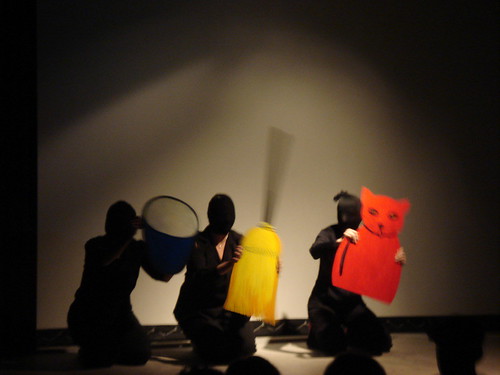
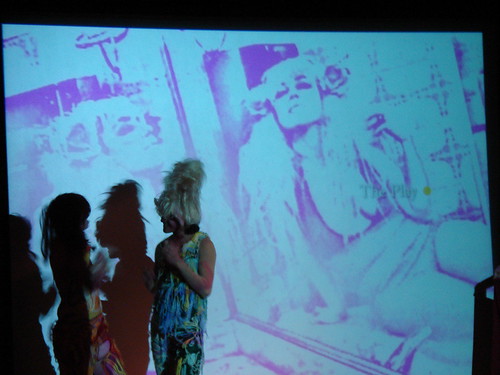
Small Press Traffic: creating a regular scene for experimental poetry, avante garde cats and walking, talking make-up brushes since 1974.
Culinary inspiration at Steve's Bistro
We might laugh, but we are reformed. Since then we've bought a mixing bowl, spice grinder, salad spinner, catfish, and cabbage, the purple kind.

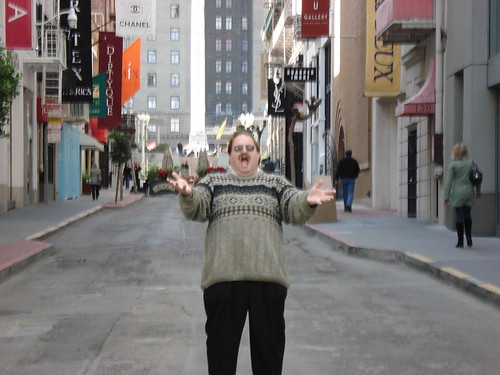
The Opera man of Maiden Lane
They've chosen Maiden Lane, I suppose for the acoustics, or the draw, but whatever it is, there they are singing loudly, demonstratively, so loudly I can barely calculate my discount at the Marc Jacobs sale. Whatevrr.
Thursday, January 11, 2007
Tuesday, January 02, 2007
Barcamp - Healthcamp: Healthcare 2.0

This was a highlight of 2006 and just happened to make it onto my calendar upon a chance reading of a Stanford email list. On a Saturday morning at Citizen Space near South Park, a group of 30-40 people showed up of their own volition to talk about how social networking, online communities and web 2.0 might change healthcare. We were a multidisciplinary group of doctors, engineers, business people, social scientists, advertisers, marketers, writers and even a family who had lost their daughter to a rare genetic disease. Conversations were informal and fluid. If you wanted to talk about something, you threw it up on the white board and anyone who wanted to join you could do so. You could walk in and out of discussions freely without worrying about hurting anyone's feelings. I stayed till 4, others were there till past dinner. I tend to get downright sentimental about stuff like this - in an age of cynicism and disappointment with our healthcare system, this gathering was a little jewel of inspiration.
Subscribe to:
Posts (Atom)