Saturday, April 12, 2008
Saturday, March 01, 2008
In our hearts...

My grandmother, Eunice Christabel D'sa, was taken from us this morning. She was surrounded by family, love and support in the comfort of her home in Bangalore, India. She is more with me in spirit today than ever before. I have to leave to get on a plane to host the Health 2.0 conference in a couple of hours. It is what she would have wanted, she was proud of this gathering and this movement. Nothing serves as a more powerful reminder of our commitment to make healthcare more human-centered than moments like this.
Monday, December 31, 2007
The year in gratitude
This year deserves a round-up. On a personal note, it was a year for taking risk, for being surprised, for learning how to collaborate, for sticking with a vision, for not being afraid to be a beginner at something, for immersive travel, for treasuring relationships in the face of mortality and loss.
I met and got to work with a brilliant group of people at Physic Ventures. Their mission, accomplishments and plans for a sustainable and healthy world are awe-inspiring. I'm honored to have been Entrepreneur-in-Residence this past year and look forward to an ongoing collaboration in 2008.

Health 2.0, the conference and community, was born. And announced its arrival through a megaphone. We are delighted that the forum is able to inspire innovators to change healthcare and now with 2 events planned in 2008, we're poised to support the evolution of this movement as it surely takes unexpected twists and turns. Esther Dyson's article about the conference in the Huffington Post is on my wall, and somewhere on my desk is the front page article from the Tech section of the SF Chronicle, where we were quoted, but the absolute best thing about the conference are times like when an entrepreneur said, "I spent 16 hrs on a plane from Israel, and I had no idea there were other companies like us, trying to do things this way. It was totally worth the trip."

And in a quieter way, a little company that we hope makes life better for doctors and patients came into the world. Starting out on paper sketches in 2005, to an executive summary exactly 1 year ago that wise friends and colleagues weighed in on, to a functioning prototype in March built by developers and designers with an average age of 20, using Google chat as our primary means of communication, to a company that will launch with a world-class team and make some waves in 2008...please meet Medly.

We moved around a lot this year. We spent a sticky summer in NYC where I studied directing and screenwriting at the School of Visual Arts.

Over the course of 10 weeks, we slept in 7 different homes or apartments, granted some of that included a trip to New Orleans and to the best kept secret in Mexico, La Isla Mujeres.

At the end of the summer, while we were still in NY, we lost two very close friends, Theresa Duncan and Jeremy Blake, in a shocking and tragic way. Enough has been written about them in blogs, in the New York Times and in Vanity Fair, so I won't add to that, but they affect us every single day, they inspire us to stay true to leading singular, authentic and creative lives above all.
The travel continued, but for mixed reasons. I spent 2 weeks in Bangalore this October to be with my grandmother who fell ill this year. It was a time of reflection and strong emotions, but I treasured every moment with the most brilliant, articulate, witty, well-read, elegant, graceful and unforgettable 92 year-old lady in India.

I have never looked forward to a year the way I'm looking forward to 2008. If it is a better year than 2007, my cup runneth over. To health, family, creativity and the pursuit of making the world a better place. Welcome 2008!

I met and got to work with a brilliant group of people at Physic Ventures. Their mission, accomplishments and plans for a sustainable and healthy world are awe-inspiring. I'm honored to have been Entrepreneur-in-Residence this past year and look forward to an ongoing collaboration in 2008.

Health 2.0, the conference and community, was born. And announced its arrival through a megaphone. We are delighted that the forum is able to inspire innovators to change healthcare and now with 2 events planned in 2008, we're poised to support the evolution of this movement as it surely takes unexpected twists and turns. Esther Dyson's article about the conference in the Huffington Post is on my wall, and somewhere on my desk is the front page article from the Tech section of the SF Chronicle, where we were quoted, but the absolute best thing about the conference are times like when an entrepreneur said, "I spent 16 hrs on a plane from Israel, and I had no idea there were other companies like us, trying to do things this way. It was totally worth the trip."

And in a quieter way, a little company that we hope makes life better for doctors and patients came into the world. Starting out on paper sketches in 2005, to an executive summary exactly 1 year ago that wise friends and colleagues weighed in on, to a functioning prototype in March built by developers and designers with an average age of 20, using Google chat as our primary means of communication, to a company that will launch with a world-class team and make some waves in 2008...please meet Medly.

We moved around a lot this year. We spent a sticky summer in NYC where I studied directing and screenwriting at the School of Visual Arts.

Over the course of 10 weeks, we slept in 7 different homes or apartments, granted some of that included a trip to New Orleans and to the best kept secret in Mexico, La Isla Mujeres.

At the end of the summer, while we were still in NY, we lost two very close friends, Theresa Duncan and Jeremy Blake, in a shocking and tragic way. Enough has been written about them in blogs, in the New York Times and in Vanity Fair, so I won't add to that, but they affect us every single day, they inspire us to stay true to leading singular, authentic and creative lives above all.
The travel continued, but for mixed reasons. I spent 2 weeks in Bangalore this October to be with my grandmother who fell ill this year. It was a time of reflection and strong emotions, but I treasured every moment with the most brilliant, articulate, witty, well-read, elegant, graceful and unforgettable 92 year-old lady in India.

I have never looked forward to a year the way I'm looking forward to 2008. If it is a better year than 2007, my cup runneth over. To health, family, creativity and the pursuit of making the world a better place. Welcome 2008!

Thursday, December 27, 2007
A brand/context mismatch!

So, I'm all for traditional brick and mortar or even Web 1.0 companies embracing the new internet ways and all, I espouse this daily on the Health 2.0 scene, but the above is just not what I want to see in my inbox, no, not at all. It might as well say the IRS is going to hunt you down, omg, lol, smiley face with wink.
Know your brand and know your place!
Sunday, November 18, 2007
Dave Eggers' response to "keeping it real" - not his phrase
I was taken by Dave Eggers' long and impassioned response to a Harvard student's interview question on "how do you keep it real?"
And here's my response to his response.
Dave Eggers' piece resonated with me. Yes to saying yes. But if this were a live conversation, I'd want to put the following to him: what about the implicit contract an artist or entrepreneur (while still early and small) makes with his or her viewer, reader, listener, user? I think Dave doesn't acknowledge that there is an intimacy to the relationship between an emerging artist and audience member/fan, a bond more imagined than real, full of unrequited passion and adolescent fantasy perhaps, but no less visceral to the early fan or the early adopter of a new technology for that matter.
When the artist or entrepreneur gets big, this notion of monogamy or mutual loyalty, albeit illusory, is shattered. So the young person, explorer/discoverer, president of a fan club of 3 feels an inexplicable sense of betrayal and moves on to support the next underdog. Remember "you were working as a waitress in a cocktail bar, when I met you. Now 5 years later, you've got the world at your feet. Success has been so easy for you. But don't forget it's me who put you where you are now and I can put you back down too. Don't you want me baby?" Creepy, yes, but kind of a hard-to-ignore part of the psyche of fan-hood.
And this goes beyond the arts. Mike Arrington, tech guru, writer, investor wrote a sad post about the state of silicon valley now vs. a number of years ago, Silicon Valley could use a downturn right now.
Small is beautiful, big can be devastatingly gorgeous and infinitely renewing, but the journey between the two is by definition a relationship between creator and experiencer and therefore inherently fraught with negotiation.
And here's my response to his response.
Dave Eggers' piece resonated with me. Yes to saying yes. But if this were a live conversation, I'd want to put the following to him: what about the implicit contract an artist or entrepreneur (while still early and small) makes with his or her viewer, reader, listener, user? I think Dave doesn't acknowledge that there is an intimacy to the relationship between an emerging artist and audience member/fan, a bond more imagined than real, full of unrequited passion and adolescent fantasy perhaps, but no less visceral to the early fan or the early adopter of a new technology for that matter.
When the artist or entrepreneur gets big, this notion of monogamy or mutual loyalty, albeit illusory, is shattered. So the young person, explorer/discoverer, president of a fan club of 3 feels an inexplicable sense of betrayal and moves on to support the next underdog. Remember "you were working as a waitress in a cocktail bar, when I met you. Now 5 years later, you've got the world at your feet. Success has been so easy for you. But don't forget it's me who put you where you are now and I can put you back down too. Don't you want me baby?" Creepy, yes, but kind of a hard-to-ignore part of the psyche of fan-hood.
And this goes beyond the arts. Mike Arrington, tech guru, writer, investor wrote a sad post about the state of silicon valley now vs. a number of years ago, Silicon Valley could use a downturn right now.
Small is beautiful, big can be devastatingly gorgeous and infinitely renewing, but the journey between the two is by definition a relationship between creator and experiencer and therefore inherently fraught with negotiation.
Saturday, November 17, 2007
A short I made in NY
So this little dab of noir was created this past summer during a directing class I took at the School of Visual Arts in NYC. We were given just a few days to write a script with the following constraints: no more than 2 pages, which translates to about 2 minutes of viewing time, 2-3 characters max, and it had to take place in a bar. I was watching and reading a lot of David Mamet and so I was obsessed with manipulation and backstabbing and hatched this little triple betrayal vignette. It was an incredible thrill to audition and cast "real" actors who live and work in New York. I had to prep the actors, talk them through their motivations, question my own writing when a particular character's decision didn't quite make sense to them, come up with a shot list, props, costumes, and I had to learn how to work with a (very talented) DP.
And I had to direct.
I will never watch a film the same way again. Forget what it takes to be a start-up CEO, being a writer-director has got to be the most incredible rush ever. You watch these characters you just dreamed up in 10 minutes come to life in front of your eyes. You watch how each subtle change an actor makes in response to your feedback can transform the entire piece. And the feeling on a set when you're working with actors who take their work seriously is magical. At the end of the last take, the entire crew burst into spontaneous applause. We were blown away by John Hart's (Jake's) performance and I just stood there dumbstruck - did I just write this tiny and temporary world into existence?
And I had to direct.
I will never watch a film the same way again. Forget what it takes to be a start-up CEO, being a writer-director has got to be the most incredible rush ever. You watch these characters you just dreamed up in 10 minutes come to life in front of your eyes. You watch how each subtle change an actor makes in response to your feedback can transform the entire piece. And the feeling on a set when you're working with actors who take their work seriously is magical. At the end of the last take, the entire crew burst into spontaneous applause. We were blown away by John Hart's (Jake's) performance and I just stood there dumbstruck - did I just write this tiny and temporary world into existence?
Wednesday, November 14, 2007
Saturday, November 03, 2007
My maternal ancestry, beginning in the mid-late 1800s
This my great-great-grandfather, Simon Podwal. The Catholics of Mangalore, a coastal town north of Goa, voluntarily converted to Christianity in the 1600s under the influence of the Portuguese. Many of these early settlers had fled the horrific, forced conversions going on in Goa, that were a part of the Inquisition.
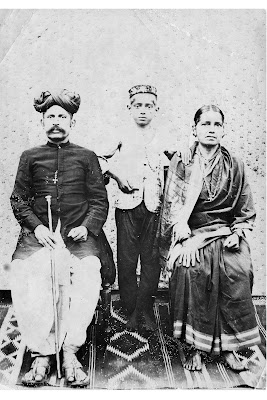
Below is Simon's son, Andrew D'sa, my great-grandfather and his first wife and daughter.

Now we have Appolinaris D'sa, my grandfather, whom I lived with as a child and loved very much. This picture was taken in 1938 in Mangalore. He is a young lawyer 2 years before he is to meet and marry my grandmother, Eunice Pinto.

Switching sides, below is a picture of Rose Pinto, my great-grandmother. She was born in 1896 and died at the young age of 24, in 1920, of Typhoid, a terrible disease at the time that claimed the lives of young mothers and children every year. She left behind 3 children, the oldest of which was my grandmother, who was 7 years old when her mother died.

And here is my grandmother, Eunice D'sa, the year she married my grandfather, in 1940. The picture is a cropped image from a group photo of the Ladies Club of Mangalore taken in honor of a visit by the British Governor's wife. This is 7 years before India's independence.

And finally my parents, Marina D'sa and Paul Subaiya in 1972. Marina was Eunice's 4th child.


Below is Simon's son, Andrew D'sa, my great-grandfather and his first wife and daughter.

Now we have Appolinaris D'sa, my grandfather, whom I lived with as a child and loved very much. This picture was taken in 1938 in Mangalore. He is a young lawyer 2 years before he is to meet and marry my grandmother, Eunice Pinto.

Switching sides, below is a picture of Rose Pinto, my great-grandmother. She was born in 1896 and died at the young age of 24, in 1920, of Typhoid, a terrible disease at the time that claimed the lives of young mothers and children every year. She left behind 3 children, the oldest of which was my grandmother, who was 7 years old when her mother died.

And here is my grandmother, Eunice D'sa, the year she married my grandfather, in 1940. The picture is a cropped image from a group photo of the Ladies Club of Mangalore taken in honor of a visit by the British Governor's wife. This is 7 years before India's independence.

And finally my parents, Marina D'sa and Paul Subaiya in 1972. Marina was Eunice's 4th child.

Wednesday, October 31, 2007
Organized chaos: a tale of an Indian city
I’ve been thinking a lot about the city, the frustration, the growing income disparities, the traffic, the roads, the politics. It’s rich in problems to solve and therefore has an undeniable appeal, I must admit. It’s been said a million times before, but it doesn’t get any less astonishing with repetition that a night at the Leela hotel costs $600 USD or 24,000 Rupees (INR), while right next door, people live in abject poverty.
Starting salary for a college grad at a reputable IT firm can be as high as 70,000 INR a month. This goes up to 500,000 to 1,000,000 INR/month for a very senior level, MBA position, whereas the woman providing home-care for my grandmother makes 2,000 INR a month. And this woman is specially trained in proving elder care, has a home of her own and must support a husband and grandson on her income. Someone just providing cleaning services and general household help would make a lot less, not to mention people working on the streets or begging for their food. As Adam Bosworth said about India in an email to me while he traveled around the country for the first time over the last couple of weeks, "it's wild and turning into two separate cultures."
And so it goes without saying that wages have not kept up with price inflation for the vast majority of the city's residents. If you buy produce off a neighborhood cart that gets wheeled around to people's homes, you can get a handful of veggies for 10-15 INR, enough for maybe two servings, and that's quite affordable for most people. But if you shop at regular retail outlets, a small cup of tea alone can be 50 rupees. Eating out at a reasonably nice restaurant, not a 5-star, not one aimed at tourists, will run you 300 – 350 INR an entrée. A haircut at a modern, clean salon can be 750 for a cut to 3000 INR for a cut and color. A soft-cover guide book to the city that I leafed through recently cost 1,200 INR! At 30 bucks US, it was outrageous even for me.
So it’s no secret that the tech industry here has created a lot of wealth for a relatively small proportion of the economy. But advocates would say the IT influx has created jobs, a larger number of people have a higher standard of living and these companies are paying taxes and abiding lawfully, contributing to the government’s coffers. But here’s the rub. While these companies indeed offer the local governments lots of money to improve infrastructure, in most cases, the politicians refuse it. Why, one wonders? Well, if money is accepted, the payer can dictate terms, handle the construction project internally or god forbid, use the most efficient machinery, processes and materials. This would mean two things to the politicians: (1) they wouldn't be able to hand out contracts to their favored friends, (2) by using state of the art equipment, fewer low wage laborers would be employed making the politician unpopular in certain communities. And so the cycle continues, money is turned down and the economy grows very unevenly without an infrastructure to support it.
And not surprisingly, departments that have jurisdiction over the city don’t talk to each other, in the mildest interpretation, and deliberately sabotage each other, in the most cynical of interpretations. My cousins mentioned examples of roads being freshly tarred and paved by one government body, only to be upturned within days by a telecom company laying down cables or a sewage commission building manholes. The upturned road is then left that way indefinitely.
But there are some encouraging movements as well. My cousins tell me the Times of India recently sponsored a competition for promising young people with a desire to enter politics. The concept being that the talented and educated amongst the next generation need to feel that politics is a viable career option. The mainstream sentiment is that the government is hopelessly corrupt and not worthy of people who want to truly be effective. Everyone was asked, “what is your big idea for India?” The candidates each pitched their visions and the winner is to get a handsome sum of money and will be groomed to implement his or her idea.
So what else will it take besides fresh talent in politics to ensure that India's urban development is sustainable and isn't a ticking time bomb both for the stock market and for the quality of life of its citizens? I’m reminded of the epidemic of obesity in the US. Here is a first world country with unparalleled access to information, education and resources. And yet people flock to fast food outlets, develop self-sabotaging health behaviors, children get diabetes younger and younger, the healthcare system crumbles under the economic pressure, and economists, physicians and elected leaders haven't made much of a dent in a trend that has gotten alarmingly worse over more than a decade. So before we shake our heads at the insanity that is urban life in India, let’s consider the herculean challenge of human behavior change at the societal level in general.
Coming at this from the Health 2.0 perspective, one insight is that positive peer pressure from like-minded groups where members provide support and influence works. Can we think of a way in which transparency and social approval/disapproval can be leveraged for change at the city level in India?
How might this work for a couple of everyday nuisances in the city, say for example, the incessant honking. I spent 45 minutes in an autorickshaw traveling about 3/4 of a mile the other day. I would have walked instead but it was dark and I was carrying an expensive DVD player; my instincts told me to hang out and wait it out. So for 45 minutes, I sat in traffic. The fumes and exhaust were nothing compared to the noise pollution. The honking was non-stop, for no apparent reason, and incredibly loud. I noticed many men on mopeds simply holding down the horn lever for an entire minute. So how do you change that behavior? Do you issue tickets and fines? Many of these people may not even have an address you can find them at, not to mention, we’re talking about hundreds of thousands of vehicles, jam packed on city streets that go on for miles. Imagine the most intricate CG image in Star Wars where you see millions of creature soldiers stretching as far as the eye can see. That’s what traffic is like traffic in Bangalore. So to me, the only way to effect change is to impose social embarrassment. If it became totally humiliating to honk, people would self-regulate. Would this require a public service announcement, or a billboard campaign, or protestors who throw out pamphlets and make themselves a nuisance until people get the message?
The same is true for peeing on the side of the street. Well-dressed men, who clearly work white-collar jobs and have homes with facilities use the side of the road in plain sight. Again, fining people is one thing, but why not a massive billboard and television campaign making vicious fun of people who do that. Consumer goods companies should be able to solve this problem in their sleep. After all we frightened Americans about body odor to sell deoderant, bad breath to sell mints and mouthwash, so we know social embarrassment works on human beings. Why can’t we employ it here for the greater public good?
Starting salary for a college grad at a reputable IT firm can be as high as 70,000 INR a month. This goes up to 500,000 to 1,000,000 INR/month for a very senior level, MBA position, whereas the woman providing home-care for my grandmother makes 2,000 INR a month. And this woman is specially trained in proving elder care, has a home of her own and must support a husband and grandson on her income. Someone just providing cleaning services and general household help would make a lot less, not to mention people working on the streets or begging for their food. As Adam Bosworth said about India in an email to me while he traveled around the country for the first time over the last couple of weeks, "it's wild and turning into two separate cultures."
And so it goes without saying that wages have not kept up with price inflation for the vast majority of the city's residents. If you buy produce off a neighborhood cart that gets wheeled around to people's homes, you can get a handful of veggies for 10-15 INR, enough for maybe two servings, and that's quite affordable for most people. But if you shop at regular retail outlets, a small cup of tea alone can be 50 rupees. Eating out at a reasonably nice restaurant, not a 5-star, not one aimed at tourists, will run you 300 – 350 INR an entrée. A haircut at a modern, clean salon can be 750 for a cut to 3000 INR for a cut and color. A soft-cover guide book to the city that I leafed through recently cost 1,200 INR! At 30 bucks US, it was outrageous even for me.
So it’s no secret that the tech industry here has created a lot of wealth for a relatively small proportion of the economy. But advocates would say the IT influx has created jobs, a larger number of people have a higher standard of living and these companies are paying taxes and abiding lawfully, contributing to the government’s coffers. But here’s the rub. While these companies indeed offer the local governments lots of money to improve infrastructure, in most cases, the politicians refuse it. Why, one wonders? Well, if money is accepted, the payer can dictate terms, handle the construction project internally or god forbid, use the most efficient machinery, processes and materials. This would mean two things to the politicians: (1) they wouldn't be able to hand out contracts to their favored friends, (2) by using state of the art equipment, fewer low wage laborers would be employed making the politician unpopular in certain communities. And so the cycle continues, money is turned down and the economy grows very unevenly without an infrastructure to support it.
And not surprisingly, departments that have jurisdiction over the city don’t talk to each other, in the mildest interpretation, and deliberately sabotage each other, in the most cynical of interpretations. My cousins mentioned examples of roads being freshly tarred and paved by one government body, only to be upturned within days by a telecom company laying down cables or a sewage commission building manholes. The upturned road is then left that way indefinitely.
But there are some encouraging movements as well. My cousins tell me the Times of India recently sponsored a competition for promising young people with a desire to enter politics. The concept being that the talented and educated amongst the next generation need to feel that politics is a viable career option. The mainstream sentiment is that the government is hopelessly corrupt and not worthy of people who want to truly be effective. Everyone was asked, “what is your big idea for India?” The candidates each pitched their visions and the winner is to get a handsome sum of money and will be groomed to implement his or her idea.
So what else will it take besides fresh talent in politics to ensure that India's urban development is sustainable and isn't a ticking time bomb both for the stock market and for the quality of life of its citizens? I’m reminded of the epidemic of obesity in the US. Here is a first world country with unparalleled access to information, education and resources. And yet people flock to fast food outlets, develop self-sabotaging health behaviors, children get diabetes younger and younger, the healthcare system crumbles under the economic pressure, and economists, physicians and elected leaders haven't made much of a dent in a trend that has gotten alarmingly worse over more than a decade. So before we shake our heads at the insanity that is urban life in India, let’s consider the herculean challenge of human behavior change at the societal level in general.
Coming at this from the Health 2.0 perspective, one insight is that positive peer pressure from like-minded groups where members provide support and influence works. Can we think of a way in which transparency and social approval/disapproval can be leveraged for change at the city level in India?
How might this work for a couple of everyday nuisances in the city, say for example, the incessant honking. I spent 45 minutes in an autorickshaw traveling about 3/4 of a mile the other day. I would have walked instead but it was dark and I was carrying an expensive DVD player; my instincts told me to hang out and wait it out. So for 45 minutes, I sat in traffic. The fumes and exhaust were nothing compared to the noise pollution. The honking was non-stop, for no apparent reason, and incredibly loud. I noticed many men on mopeds simply holding down the horn lever for an entire minute. So how do you change that behavior? Do you issue tickets and fines? Many of these people may not even have an address you can find them at, not to mention, we’re talking about hundreds of thousands of vehicles, jam packed on city streets that go on for miles. Imagine the most intricate CG image in Star Wars where you see millions of creature soldiers stretching as far as the eye can see. That’s what traffic is like traffic in Bangalore. So to me, the only way to effect change is to impose social embarrassment. If it became totally humiliating to honk, people would self-regulate. Would this require a public service announcement, or a billboard campaign, or protestors who throw out pamphlets and make themselves a nuisance until people get the message?
The same is true for peeing on the side of the street. Well-dressed men, who clearly work white-collar jobs and have homes with facilities use the side of the road in plain sight. Again, fining people is one thing, but why not a massive billboard and television campaign making vicious fun of people who do that. Consumer goods companies should be able to solve this problem in their sleep. After all we frightened Americans about body odor to sell deoderant, bad breath to sell mints and mouthwash, so we know social embarrassment works on human beings. Why can’t we employ it here for the greater public good?
Thursday, October 25, 2007
Karl Rove's Republicanism or why the Democrats are more closely aligned with internet culture
I wrote this post earlier in the year, before Karl Rove left the White House, and forgot about it. I decided to bring it back since I've been thinking a lot about how the web is changing our lives.
The thing about comparing Republicans and Democrats is that it's not an apples to apples comparison. I’d argue that they are two different constructs that as a function of necessity and history have been described as two political parties, but really it would be like comparing a noun and a car, or a fruit and philosophy – things that might share some common elements but really should not be the basis for meaningful comparisons. Listening to Karl Rove talk about his party's "mission" and Tom Delay talk about global warming, I get the sense that each party is running a separate race, not against each other with a common definition of success, but separate battles altogether.
Enter bias. Democrats seem to pursue change based on humanitarian ideals, whereas Republicans seem to pursue control in the name of more abstract ideals. It is interesting that Karl Rove's Republican rhetoric involves use of the word “natural” so often. A "natural majority" for example. Because he knows that to further his party's agenda requires skillful and heavyhanded masterminding, precisely because the agenda is...unnatural. It is unnatural to protect extreme wealth in the face of huge economic disparities, to believe so strongly in individualism that we ignore compassion. It is unnatural to deny our responsibility in damaging the earth.
Karl Rove observes two important trends: that people want individual responsibility/market forces and that they crave spirituality. I actually agree, but I think he is dead wrong about how we will get there. I believe people will seek a new level of wholeness and fulfillment in their lives but not by flocking to evangelical churches, but rather by tuning into their environments, joining communities for social change, paying more attention to their health, examining their role in social inequity and demanding greater transparency from their institutions. And yes people want market forces; Karl Rove cites Ebay. But he draws a totally weird conclusion about free markets. What people are really doing on Ebay is building a new economy of trust, by proving that the individual empowered by information and access to resources will be a creative, productive force of “good” in the world. Communities will form that will self-regulate. Groups will learn. Ethics will not have to be sleazily forced by political machinery; a point totally lost on Karl Rove. A sense of collective morality can grow if you believe in people. And this is really what the internet ethic is about; what we are seeing evolve in the socially networked world some of us are lucky enough to live in.
Rove's brand of Republicanism isn't about this at all. According to him, unless the party is hypervigilant and controlling of the message it will lose its grip. It's the essence of old school, top-down, unidirectional media; web 0.0. And probably, his fear is justified, because his version of the party line is inherently unnatural and precarious to begin with. It requires a politics of fear and insecurity. Not unlike what would be spouted by dictators who live with the constant threat of a coup because deep down inside they know they've wrested power, not earned it; that the principles for which they stand would not be the logical outcome of truly democratic debate. Instead the message needs to be constantly repositioned and framed so that it's never seen for the Emperor's new clothes that it is.
The thing about comparing Republicans and Democrats is that it's not an apples to apples comparison. I’d argue that they are two different constructs that as a function of necessity and history have been described as two political parties, but really it would be like comparing a noun and a car, or a fruit and philosophy – things that might share some common elements but really should not be the basis for meaningful comparisons. Listening to Karl Rove talk about his party's "mission" and Tom Delay talk about global warming, I get the sense that each party is running a separate race, not against each other with a common definition of success, but separate battles altogether.
Enter bias. Democrats seem to pursue change based on humanitarian ideals, whereas Republicans seem to pursue control in the name of more abstract ideals. It is interesting that Karl Rove's Republican rhetoric involves use of the word “natural” so often. A "natural majority" for example. Because he knows that to further his party's agenda requires skillful and heavyhanded masterminding, precisely because the agenda is...unnatural. It is unnatural to protect extreme wealth in the face of huge economic disparities, to believe so strongly in individualism that we ignore compassion. It is unnatural to deny our responsibility in damaging the earth.
Karl Rove observes two important trends: that people want individual responsibility/market forces and that they crave spirituality. I actually agree, but I think he is dead wrong about how we will get there. I believe people will seek a new level of wholeness and fulfillment in their lives but not by flocking to evangelical churches, but rather by tuning into their environments, joining communities for social change, paying more attention to their health, examining their role in social inequity and demanding greater transparency from their institutions. And yes people want market forces; Karl Rove cites Ebay. But he draws a totally weird conclusion about free markets. What people are really doing on Ebay is building a new economy of trust, by proving that the individual empowered by information and access to resources will be a creative, productive force of “good” in the world. Communities will form that will self-regulate. Groups will learn. Ethics will not have to be sleazily forced by political machinery; a point totally lost on Karl Rove. A sense of collective morality can grow if you believe in people. And this is really what the internet ethic is about; what we are seeing evolve in the socially networked world some of us are lucky enough to live in.
Rove's brand of Republicanism isn't about this at all. According to him, unless the party is hypervigilant and controlling of the message it will lose its grip. It's the essence of old school, top-down, unidirectional media; web 0.0. And probably, his fear is justified, because his version of the party line is inherently unnatural and precarious to begin with. It requires a politics of fear and insecurity. Not unlike what would be spouted by dictators who live with the constant threat of a coup because deep down inside they know they've wrested power, not earned it; that the principles for which they stand would not be the logical outcome of truly democratic debate. Instead the message needs to be constantly repositioned and framed so that it's never seen for the Emperor's new clothes that it is.
India's community identities
It is the way one wears her sari, the fabric her sari is made of, the way one greets a friend, the way one cooks chicken, or whether one eats chicken at all. “We are this way” is a common expression pronounced with the Indian equivalent of a Talmudic shrug. “We” refers to the mirco-identity of a small group, categorized and defined by a complex intersection of race, religion, geography, occupation, social standing, family ties. It’s like looking under a microscope at what would be a monolith to the naked eye. At my Aunt’s home the other day, four guests were saying goodbye. I just nodded and smiled at the Manglorian Hindu couple, but kissed the Manglorian Christian woman on both cheeks and shook the hand of the Manglorian Christian man – everyone participated in the goodbye rituals intuitively and seamlessly and to have done anything differently would have crossed a subtle line in social conduct.
Tuesday, October 23, 2007
Algebra class in the apartment
Aunt Rhoda is awesome. Once a week she takes 5 girls from underprivileged backgrounds through their math homework - today I listened in on a lesson about the quadratic equation. These girls were taken in by nuns because they either don't have families who can provide for them or they don't have families at all. They gathered around my Mac to see pictures of themselves, full of giggles. Over the years, four of Aunt Rhoda's students from this lot have gone on to college, something she is justifiably proud of.


Guests
We had a slew of guests today: a woman doctor who is instituting AIDS awareness programs in middle schools in Mumbai despite the wild protests of the Hindu fundamentalist party (they aren’t allowed to call it sex education), her husband, an international bridge champion to whom I lent the New Yorker issue with the article about Garry Kasparov, the Russian chess phenom whom I learned he admired and their daughter a homeopath who works out of her home. Conversation went from how out of control autorickshaw drivers were in Bangalore, refusing to take customers if the distance is too short and extorting people for high fares (the situation was pronounced “beyond redemption” because even if you took it to the highest level, the police commissioner turns out to be our own cousin and he just laughs and says, why not just pay the extra 20 rupees), to the stock market and how much higher it could go without collapsing, to the latest Hindi movie about an Indian coach who leads a girls hockey team to success. The actor, Shahrukh Khan is now getting requests to teach leadership in management programs across India. It's just the "glamour quotient" said the woman doctor. We served foie gras I'd bought at the airport in Brussels, on crackers topped with cucumber in the shape of bows.
After they left, my cousins Shona and Sam came by bringing biryani for lunch from a local restaurant. They said they’d deliberately picked a less spicy kind for me which was totally unnecessary since I relish the real Southern Indian version. We then combed the pages of a society magazine as my cousin picked out all the people she knew. "This guy is only 26 and married this woman in her 40s, but she doesn’t look her age," we observed as we leafed through.
After they left, my cousins Shona and Sam came by bringing biryani for lunch from a local restaurant. They said they’d deliberately picked a less spicy kind for me which was totally unnecessary since I relish the real Southern Indian version. We then combed the pages of a society magazine as my cousin picked out all the people she knew. "This guy is only 26 and married this woman in her 40s, but she doesn’t look her age," we observed as we leafed through.
Monday, October 22, 2007
The requisite walk down Brigade Road
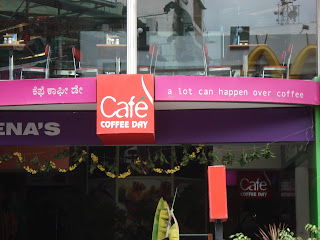
I went out on my first stroll today. I got my eyebrows done at a Chinese beauty salon on Residency Road. I desperately wanted to photograph the inside with all the patrons but chickened out at the last minute. It was a tiny room staffed by dark skinned Asian girls dressed in maroon outfits. Many seemed not much older than 13. They expertly threaded and waxed and spoke in Hindi. In close proximity were other women getting their hair done and their feet soaked. I then went by Nilgiris which has been around for more than a hundred years, where I bought chocolate cake and green tea for Mummy, murkus, pears, pomegranates, custard apples and chickoos, the latter two fruits I've only seen in India. It felt good to go on this outing. Bangalore seemed familiar. I was livid that the promenade on MG road was being brought down to build a monorail. Later Aunt Rhoda said it was like a stab in the heart for long time Bangalore residents. That promenade on MG Road was Bangalore. I agreed.




Sunday, October 21, 2007
Watching the Indian CNN at Mumbai's aiport
Adopt an Indian dog
Get a set of Cds, now only Rs 1999!
The Sensex rose after a sharp fall.
A Karachi bomb blast kills 150.
But Benazir Bhutto, the target, is safe and back in Pakistan after 8 years in exile.
It’s the festival of Durga and people are dancing the night away.
That was just from a 4 min. snippet of news.
Even the news seems different now. There is something like a Good Morning America show with a cheerful woman host, called Breakfast with India. The words "optimism" and "energy" wouldn’t be inappropriate. People are dressed differently. There is definitely a layer of lifestyle here that is very close to our lifestyle in the west. I haven’t left the airport, so it remains to be seen how widespread the change is. A young man died unexpectedly soon after his wedding and his family and the public took to the streets in protest, crying foul-play and accusing a prominent politically connected family of murder – the words, "clean and transparent process" and "truth" are being thrown around. Democracy is alive and well.
While the airport is newly renovated, there are still 400,000 slum dwellers right around the runway that are going to have to be displaced as the airport expands. This has already caused a storm of controversy. As our bus wound its way from the international to the domestic terminal, over the walls of the airport grounds, I could see Christmas lights hanging on the houses and on the streets in the slums in celebration of the Dhasara festival.
Get a set of Cds, now only Rs 1999!
The Sensex rose after a sharp fall.
A Karachi bomb blast kills 150.
But Benazir Bhutto, the target, is safe and back in Pakistan after 8 years in exile.
It’s the festival of Durga and people are dancing the night away.
That was just from a 4 min. snippet of news.
Even the news seems different now. There is something like a Good Morning America show with a cheerful woman host, called Breakfast with India. The words "optimism" and "energy" wouldn’t be inappropriate. People are dressed differently. There is definitely a layer of lifestyle here that is very close to our lifestyle in the west. I haven’t left the airport, so it remains to be seen how widespread the change is. A young man died unexpectedly soon after his wedding and his family and the public took to the streets in protest, crying foul-play and accusing a prominent politically connected family of murder – the words, "clean and transparent process" and "truth" are being thrown around. Democracy is alive and well.
While the airport is newly renovated, there are still 400,000 slum dwellers right around the runway that are going to have to be displaced as the airport expands. This has already caused a storm of controversy. As our bus wound its way from the international to the domestic terminal, over the walls of the airport grounds, I could see Christmas lights hanging on the houses and on the streets in the slums in celebration of the Dhasara festival.
Brussels to Mumbai
We landed in a toxic steam bath, on a dark runway where long, sleek bird-like planes slowly crawled between the shadows. I'm on a hellish, totally unexpected, I’m going to murder my travel agent, lay-over in Mumbai at 2 AM with 4 and half more hours to go. The trip has gone rapidly downhill as I am exhausted, dehydrated, hungry and headachy. How is it considered acceptable to have me check in go through customs, baggage claim, then re-check in and get on a bus to a different airport to catch a domestic flight after waiting 5 hours in the middle of the night? How is that not an important detail to mention when booking a ticket? So I’m not happy, I will not arrive all that happy. And this is just the beginning of the hard stuff.
On the flight from Brussels to Mumbai, a little boy baby cried his head off inconsolably. People looked up from their newspapers and laptops shaking their heads, cursing their seat assignments. The baby kept escalating his tantrum. And then out of nowhere, a few grandparently people from across the aisle began to stir. “Put him on your shoulder," “ “No don’t turn him that way”, “You shouldn’t talk to him,” “Hold him this way and pat; a baby needs to feel a beating heart.” Arms went up from several rows down offering to carry and pacify the screaming monster. This collective Indian parenting effort was really something to watch. The young to middle aged people were annoyed, but the elders seemed transported to a different time, when they were once new parents. They were only too happy to help.
On the flight from Brussels to Mumbai, a little boy baby cried his head off inconsolably. People looked up from their newspapers and laptops shaking their heads, cursing their seat assignments. The baby kept escalating his tantrum. And then out of nowhere, a few grandparently people from across the aisle began to stir. “Put him on your shoulder," “ “No don’t turn him that way”, “You shouldn’t talk to him,” “Hold him this way and pat; a baby needs to feel a beating heart.” Arms went up from several rows down offering to carry and pacify the screaming monster. This collective Indian parenting effort was really something to watch. The young to middle aged people were annoyed, but the elders seemed transported to a different time, when they were once new parents. They were only too happy to help.
Today’s news
October 19th
Bush said to Iran today, “we will isolate you” referring to his zero tolerance policy for their efforts to build nuclear capabilities. It’s ironic since now, more than ever, it’s America who is isolated. With our weak dollar and lack of moral credibility, we are forcing a realignment of affinities even among our once friends. The joke about Bush bonding with Putin on his visit to W’s ranch is more than not funny, now that Putin is befriending Iran. China is cutting deals with Iraq, and so is Iran. Turkey is ready to take matters into its own hands with Baghdad, having given up on the US helping with the issue of the Kurds on their border. There is some serious huddling and whispering going on in them Eastern regions and Bush is not invited, and therefore we are not invited. There are new affinities forming, drawing into stark relief the real catalyst for the frightening but not so unreasonable threat of a WWIII, that Bush naively attributes to Iran getting nuclear.
Bush said to Iran today, “we will isolate you” referring to his zero tolerance policy for their efforts to build nuclear capabilities. It’s ironic since now, more than ever, it’s America who is isolated. With our weak dollar and lack of moral credibility, we are forcing a realignment of affinities even among our once friends. The joke about Bush bonding with Putin on his visit to W’s ranch is more than not funny, now that Putin is befriending Iran. China is cutting deals with Iraq, and so is Iran. Turkey is ready to take matters into its own hands with Baghdad, having given up on the US helping with the issue of the Kurds on their border. There is some serious huddling and whispering going on in them Eastern regions and Bush is not invited, and therefore we are not invited. There are new affinities forming, drawing into stark relief the real catalyst for the frightening but not so unreasonable threat of a WWIII, that Bush naively attributes to Iran getting nuclear.
En Route to Bangalore
It’s 10:30 PM EST and I’m somewhere over the Atlantic on a plane, but it’s no ordinary plane. I’m on a brand new Jet Air flying machine. This company, perhaps the Virgin Airways or Jet Blue of India is kicking it’s predecessor’s butt all the way into pre-outsourcing times and at the rate of growth in this economy, it wouldn’t be unreasonable to ask if that was when giant long necked lizardy things roamed the earth. Jet Air has enough polish and panache to rouse the most closeted of nationalist sentiments within someone of Indian origin - where or where shall I begin?
A bathroom on Air India. You’re better off waiting out the 24 hr. flight.
A bathroom on Jet Air. A bottle of basil and bergamot eau de toilette, hand lotion with essential oils, air freshening spray.
A meal on Air India. A passable Indian TV dinner at best.
A meal on Jet Air: Oh man, it was so good! The meal was served on a pink, orange and yellow striped tablemat with a red and orange brocade cloth napkin tied in a shiny orange ribbon. There was a warm paratha (Indian flat bread), a side of yogurt sauce and tomato salad, mango pickle, mushrooms, and corn in a light curry with ground cashew nuts. The rice was delicious and served with sautéed onions. The dessert was a classic Indian rice pudding in rose flavored sauce with two succulent strawberries. Hot towels were passed both before and after the meals. The crew is super young and gorgeous. They are dressed to impress. Hair, makeup, incessant smiles, the works – it’s enough to make one nostalgic for the days when flying was sexy and stewardesses were glamorous.
Then there’s the in-flight entertainment system. Touch screen, with a remote control hand piece and keyboard, a great selection of features, short films, television, news. There is a ton of legroom and an outlet for my laptop in my armrest. I grabbed copies of the NY Times and the Times of India from right behind me in a convenient magazine rack and settled into my journey back to the city I was born in.
A bathroom on Air India. You’re better off waiting out the 24 hr. flight.
A bathroom on Jet Air. A bottle of basil and bergamot eau de toilette, hand lotion with essential oils, air freshening spray.
A meal on Air India. A passable Indian TV dinner at best.
A meal on Jet Air: Oh man, it was so good! The meal was served on a pink, orange and yellow striped tablemat with a red and orange brocade cloth napkin tied in a shiny orange ribbon. There was a warm paratha (Indian flat bread), a side of yogurt sauce and tomato salad, mango pickle, mushrooms, and corn in a light curry with ground cashew nuts. The rice was delicious and served with sautéed onions. The dessert was a classic Indian rice pudding in rose flavored sauce with two succulent strawberries. Hot towels were passed both before and after the meals. The crew is super young and gorgeous. They are dressed to impress. Hair, makeup, incessant smiles, the works – it’s enough to make one nostalgic for the days when flying was sexy and stewardesses were glamorous.
Then there’s the in-flight entertainment system. Touch screen, with a remote control hand piece and keyboard, a great selection of features, short films, television, news. There is a ton of legroom and an outlet for my laptop in my armrest. I grabbed copies of the NY Times and the Times of India from right behind me in a convenient magazine rack and settled into my journey back to the city I was born in.
Wednesday, October 10, 2007
Why do we put up with software for Windows only?
Developers PLEASE stop creating beta versions of things that only run on Windows. Mac users by definition are early adopters and tastemakers - thinking about us after the fact is not just super irritating but it would seem to me that it's bad business. Stop thinking about sheer market size and think about the type of customer you want, your ultimate adoption curve and the potential to create a lasting brand. Yahoo's news videos used to be PC only, I think now they've changed, but they lost me as a user. I just tried to download Times Reader. Bad, bad, only for Windows. And not to mention MS's Healthvault, but that's at least just plain predictable.
Oh and yes, I just bought a mac that can run windows. But it's just so distasteful to have to make the switch and not all macs are configured for this anyway.
Oh and yes, I just bought a mac that can run windows. But it's just so distasteful to have to make the switch and not all macs are configured for this anyway.
Sunday, October 07, 2007


Subscribe to:
Posts (Atom)